Art O'Neill Walk
The Art O’Neill Walk 2007
It’s always exciting making one’s way to Dublin Castle for the Art O’Neill
Walk. What adds to the anticipation is wondering how many are going to turn up
on the night since this is a no fee/no pre-entry event. Sometimes the plans made
after too much Christmas pudding and turkey fade away as the night of the event
approaches. In 1998, before the walk was promoted on the internet, only four
people turned up. Since then things have changed somewhat. Indeed, on this
Friday night, 5th January, 2007, four hundred and fifteen years after the escape
of Red Hugh O’Donnell and Art and Henry O’Neill in 1592, over sixty walkers
turned up for the challenge. The challenge consists of forty-six kilometers by
road and track and 18 kilometers over open mountain, with half the walk taking
place in darkness.
Without any fanfare (we didn’t want to awaken Queen Elizabeth’s guards) the
long column of widely varying shapes and ages headed off into the night as the
midnight hour arrived. Very soon a few runners from Belfast careered into the
night, leaving the main body of walkers in wonderment at their fitness. Up
Patrick Street, out to Harold’s Cross, on to Templeogue and past the Old Mill in
Tallaght, the group soon found itself without street lights, in outer darkness,
as the Dublin Hills were reached. Passing by the Kilbride Army Camp at 3.30am, a
welcome cup of soup and a slice of cake was generously supplied by the small
group of regular volunteers from the Wayfarers Hillwalking Club, led by Grace
Dobson. Pat Lynch, who was to provide backup throughout the length of the walk,
and also other Wayfarers, had transported carloads of backpacks to this point.
With a quick change into boots and head torches, the journey through fields and
along country roads to Ballynultagh Gap began. Very soon, however, it started to
rain and would continue for the next three or four hours. It’s at Ballynultagh
Gap that the first mountain, Black Hill, is tackled. Up till now the hikers had
been walking at their own individual paces without concerning themselves about
whether they were in touch with the group. However, at Ballynultagh Gap nobody
seemed to want to wander up Black Hill alone and around to Billy Byrne’s Gap in
mist and darkness. They gathered here waiting for someone with a compass to
appear, looking as if he knew how to use it. One fast-footed pair nevertheless
headed off ahead of the group and soon disappeared into the murky night.
Unfortunately, lacking a compass and only equipped with ‘a good sense of
direction‘, they soon found themselves sitting on the slopes below Billy Byrne’s
Gap waiting for daylight so that they could find out where they were!
Fortunately, the main group of fifty-eight (two had fallen behind at Kilbride)
spotted their head torches as they contoured, using a compass, around to the Gap
and all were united again. Daylight came on the descent to the hamlet of
Glenbride, and the tiring walkers stretched out in a long line as they made
their way downwards through broken ground and rough heather.
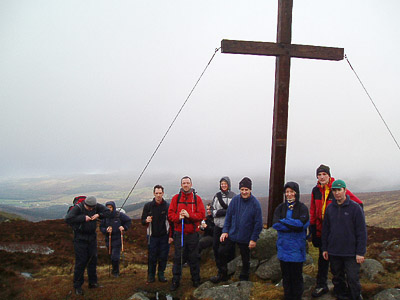 It
was 9.30am at Ballinagee Bridge and the forty kilometer point had been reached.
It was time for a rest, food and drink and a change of socks, etc.
Unfortunately, two walkers withdrew at this point due to blisters and knee
problems. The other two who had fallen behind at Kilbride were also out of the
equation. With a bright day and pleasant weather, everyone now proceeded at
their own pace up along the Glenreemore Brook to Art’s plaque and the final
climb of the day to Art’s Cross. The biggest group at this stage was the slowest
moving, but gradually they made their way at a relaxed pace over to Three Lakes,
down the Avonbeg river and along Table Track to Baravore in Glenmalure. Many
withdrew at this stage (formerly the finishing place) while others made their
way to the finish at Greenane (64k) and the remnants of Fiach MacHugh O’Byrnes
fortress. The runners from Belfast finished around 2pm while the earliest
walkers were in Greenane after 3pm. Most would have finished between 4pm and
5pm. Once again, Pat Lynch of the Wayfarers provided transport from the finish
to anyone who required a lift to the train in Rathdrum. As a long-distance
walker himself, only he could appreciate small mercies like this at the end of a
long trek. The next train to Dublin wasn’t until 7.30pm, but those who made
their way to Rathdrum mixed with the Saturday afternoon café society as they
enjoyed a well-deserved meal and a pint or two in the salubrious environs of
that town.
It
was 9.30am at Ballinagee Bridge and the forty kilometer point had been reached.
It was time for a rest, food and drink and a change of socks, etc.
Unfortunately, two walkers withdrew at this point due to blisters and knee
problems. The other two who had fallen behind at Kilbride were also out of the
equation. With a bright day and pleasant weather, everyone now proceeded at
their own pace up along the Glenreemore Brook to Art’s plaque and the final
climb of the day to Art’s Cross. The biggest group at this stage was the slowest
moving, but gradually they made their way at a relaxed pace over to Three Lakes,
down the Avonbeg river and along Table Track to Baravore in Glenmalure. Many
withdrew at this stage (formerly the finishing place) while others made their
way to the finish at Greenane (64k) and the remnants of Fiach MacHugh O’Byrnes
fortress. The runners from Belfast finished around 2pm while the earliest
walkers were in Greenane after 3pm. Most would have finished between 4pm and
5pm. Once again, Pat Lynch of the Wayfarers provided transport from the finish
to anyone who required a lift to the train in Rathdrum. As a long-distance
walker himself, only he could appreciate small mercies like this at the end of a
long trek. The next train to Dublin wasn’t until 7.30pm, but those who made
their way to Rathdrum mixed with the Saturday afternoon café society as they
enjoyed a well-deserved meal and a pint or two in the salubrious environs of
that town.
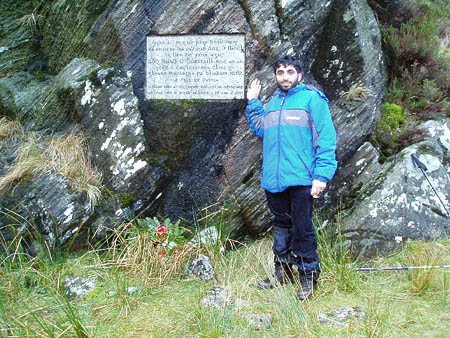 Fifty-seven
of the starters got at least as far as Baravore, the finishing place until this
year, while about a dozen from that group went all the way to Greenane at
sixty-four kilometers. Everyone who made a serious effort to do his or her best
came away from the event very pleased to have participated in this commemoration
of the journey of the two Irish Princes to the valley of Glenmalure (Henry
O‘Neill parted from their company in Dublin), although Art O’Neill unfortunately
died of exposure and exhaustion in the valley below the present-day Art’s Cross.
This walk has a lot of road and track in it and half of it happens in darkness.
Hillwalkers normally don’t like that arrangement of terrains, but the
strangeness and unusual nature of the Walk, allied with the dramatic story it
commemorates, makes it a journey everyone remembers with satisfaction,
especially those who joined us from far-flung places like Sweden, Germany and
the Sultanate of Oman.
Fifty-seven
of the starters got at least as far as Baravore, the finishing place until this
year, while about a dozen from that group went all the way to Greenane at
sixty-four kilometers. Everyone who made a serious effort to do his or her best
came away from the event very pleased to have participated in this commemoration
of the journey of the two Irish Princes to the valley of Glenmalure (Henry
O‘Neill parted from their company in Dublin), although Art O’Neill unfortunately
died of exposure and exhaustion in the valley below the present-day Art’s Cross.
This walk has a lot of road and track in it and half of it happens in darkness.
Hillwalkers normally don’t like that arrangement of terrains, but the
strangeness and unusual nature of the Walk, allied with the dramatic story it
commemorates, makes it a journey everyone remembers with satisfaction,
especially those who joined us from far-flung places like Sweden, Germany and
the Sultanate of Oman.
Here’s to next year!
Report on Walks 2005
There were two walks this year, a harder and a "relaxed".
Harder Despite a severe weather warning from Met Eireann of
heavy rain with accompanying 70-80mph winds, especially in the East of the
country, the annual Art O'Neill Walk took place as usual on Friday night, 7th
January, 2005. After warning those who turned up at midnight outside Dublin
Castle that the Walk was 'officially' off due to the expected severe weather
conditions, 16 hardy souls (all those who turned up) walked into the night and
out to the Dublin hills. The plan was to walk as far as Ballynultagh Gap (30k)
and assess the weather at that stage so as to see if it was safe to enter the
more rugged (and possibly dangerous) terrain of the higher mountainous regions.
The winds as we approached Stone Cross at Ballinascorney gave us a taste of what
might lie ahead of us. If the wind was so strong now at low level what might it
be around Black Hill and Billy Byrne's Gap as we contoured our way around to the
latter location. At Ballynultagh it was deemed safe to continue on, so the
already tiring group made their way along the rocky track to the small cairn
atop Black Hill. It was at this stage that I'm sure I heard Someone say
'Gotcha!', for, just as as we arrived, a dreadful blast of wind and a
sleet-laden blizzard came upon us with a vengeance. Being buffeted about in zero
visibility and constantly having to wipe the sleet off the compass, it was
difficult to navigate with any great accuracy, but we did manage to steer a
course around to the Gap and arrived as the first rays of light were lighting up
the cold morning sky. It was at the Gap that Someone seemed to say 'Ok, folks,
you did well. Your courage didn't let you down' ......and the wind and the rain
stopped as if like magic. Tiredness was now evident amongst some of the group,
and some began to trail off at the back as we descended to Glenbride. It was
then down through some fields to Ballinagee bridge, where some of the group had
friends to ply them with soup and other refreshments. Two participants decided
to withdraw at this stage (sore feet and knees). After a break of about 30
minutes (it was now bitterly cold) it was decided to split the group into two:
one group of seven moving faster into the remaining section of the Walk, and the
other group of seven taking a more leisurely approach. Moving up the Glenreemore
brook to Art's grave, the final ascent of the day to art's Cross followed. It
was then on to Three Lakes (both of them), down to the Avonbeg river and finally
to the finish at Baravore in Glenmalure, where warm cars and welcoming
supporters, like veteran long-distance walker Pat Lynch of the Wayfarers, made
it all seem worthwhile. My compliments to all those who participated in this
year's Walk, who showed responsibility and respect for others by preparing
properly for the event and making the trek such a success.
Tom Milligan
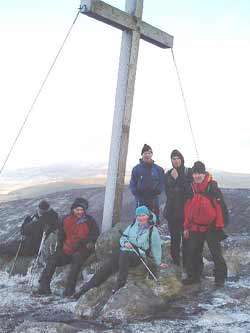 |
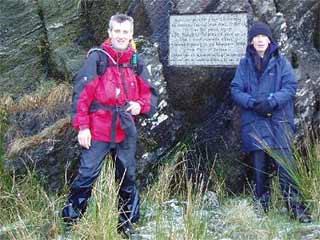
Above Michael Neary and Tom Milligan at Art's Plaque
Left "The Final Peak" -- Art's Cross
Photos by Michael Neary |
Relaxed Version The Art O'Neill Walk (Relaxed Version) took
place at midnight on Friday night, 14th January, 2005. There were eleven
participants, consisting mostly of scuba-divers with a few walkers thrown in.
The route and starting time were the same as the previous week's outing, but
this time relaxation and enjoyment were the key words. All backpacks were
transported to Kilbride where soup and Christmas cake were provided by Wayfarers
Paddy Hackett, Grace and Pat. Pat Lynch (Wayfarer) also assisted on the
night/morning/afternoon, and met the group at key points all along the route and
providing transport home at the end. Two scuba divers and one walker withdrew at
the Kilbride soup-kitchen, leaving six scuba-divers and two hikers to head off
into the hills at Ballynultagh Gap. At Ballinagee bridge the final dropout
occurred when a scuba-diver decided not to continue due to severe chafing from
his flippers. This left the leader with two hikers and four scuba-divers (all
first-timers). At 2.30pm in the afternoon the group reached Baravore, feeling a
little washed-out and all-at-sea, but nevertheless in very cheerful form because
their accomplishment. This outing was certainly the most enjoyable one that I've
ever led due to the cheerfulness of the group who, despite some unusual and
suspect gear, maintained a great sense of teamwork and mutual support. A
memorable occasion for all (especially the memory of one scuba-diver lady as she
massaged her face with moisturizing cream and her lips with balm as we were
descending from Billy Byrne's Gap!). Here's to next year!
Report on Walk 2004
The 2004 Art O'Neill Walk, in commemoration of the escape of Art O'Neill and
Red Hugh O'Donnell on the 6th January 1592, took place in conditions which
proved to be much better than that which the forecasts had suggested.
Undoubtedly many had stayed away because of the dire predictions. The 45
participants who headed off into the night from Dublin Castle enjoyed moderately
cool conditions with NO rain throughout the night and the following day.
Although there was much cloud in the skies the full moon managed to pierce
through the blanket and provide sufficient light to enable most people to
dispense with head torches. The landscape could be discerned fairly well and
this made for a more enjoyable occasion. Outside the Kilbride Army Camp (at
3.30am) soup and refreshments were voluntarily (and freely) provided by Paddy
Hegarty and his merry band of chefs. This provided for a welcome moment to
change footwear and prepare for the journey ahead. At this point three walkers
availed of a lift back to town in the car of Milo Kane, who had also transported
many of the backpacks to this point in the Walk. Previously one person withdrew
around Bohernabreena when his voice could be heard exclaiming from way behind
the group "I'm finished. I'm going back." The pace of the walking from
the Castle can be a little bit too enthusiastic for many! At Ballinagee Bridge,
at 9am, Richard More-O'Ferrrall had set up 'Art's Kitchen' and plied us all with
bowls of porridge, in aid of Dublin Wicklow Mountain Rescue. One person withdrew
at this point (Richard's porridge is under suspicion!). Most people finished the
Walk, despite sore limbs and drooping eyelids, around 2pm, with 4 Donegal lads
finally arriving at Baravore around 3pm - and still not a drop of rain.
Tom Milligan
Report on Walk 2003
At midnight on a cool Friday night on January 10th, 57 walkers from various
hillwalking clubs around Ireland headed off on the annual Art O'Neill Walk
in commemoration of the escape of Art O'Neill, Henry O'Neill and Red Hugh
O'Donnell from Dublin Castle in 1592. The crisp, dry conditions were
perfect for walking and a very pleasant journey was made by all through the city
streets and suburbs until the Kilbride Army Camp at Shankill was reached at
around 3am. Hot soup provided by members of the Wayfarers Hillwalking Club
was enthusiastically welcomed by the slowly tiring group as they changed into
their boots.
Unfortunately, just before this break we had our first casualties. One
lady hurt her knee when she tripped and fell around Boherbreena and had to
summon her husband for transport home. Another trio of gentlemen withdrew
at this point also when their bodies told them that discretion was the better
part of valour. Proceeding down through various fields under the guidance
of our leader, Joe Gilvarry, we crossed Ballysmuttan Bridge and soon found
ourselves at Ballynultagh Gap at 6am where we made our entry into the heart
of the snow-covered Wicklow Hills.
 |
 |
 |
 |
| Billy Byrne's Gap |
At Art's Plaque |
On to Art's Cross |
Art's Kitchen |
As we reached Billy Byrne's Gap the dawn was beginning to break and the group
paused for a few minutes to enjoy the golden glow of a rising winter sun.
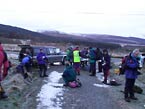
An hour or so later we enjoyed a hearty 'porridge and tea' breakfast organised
by the ever cheerful host of Jigsaw Cottage, Richard More-O'Ferrall.
Donations from the walkers, in aid of Mountain Rescue, amounting to
more than €220 were gratefully accepted on their behalf by Richard and soon we
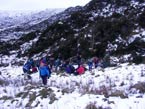
were on our way up the Glenreemore Brook to Art's grave. The condition of
the group was visibly deteriorating at this stage and several speedier and
fitter walkers disappeared onto the higher hills. However, with a little
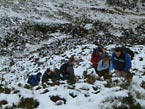
coaxing everyone managed to make the steep ascent to Art's Cross on the
hilltop overlooking the grave.
From there on it was just a matter of trudging one's way through the heavy
snow down to the Avonbeg river and onto Table Track which led a sore and
weary party to the finish at Baravore car park in Glenmalure. The average
finishing time was between 1.30pm and 2pm. Almost everyone had transport
arranged for themselves at this point, but the usual trio of Taylor, Purcell and
Milligan headed down the valley, up onto Borenacrow and down the Spink to
Glendalough where their chauffer driven (Gerry Maguire) cadillac whisked them to
their respective destinations. All in all, a very satisfying time was had
by everyone who finished the trek. Indeed, Tommy Taylor, that grizzled
72-year-old veteran of 19 outings of this walk, declared the conditions to be
the best he has ever encountered.
Some more pictures:
 |
 |
 |
 |
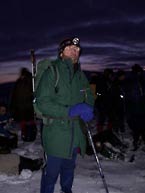
| Tommy Taylor at Billy Byrne's Gap |
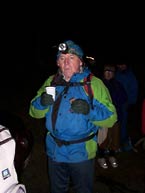
Pat Lynch, veteran Wayfarer (and veterinarian) |
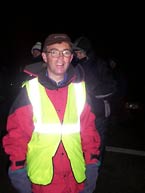
Michael Purcell |
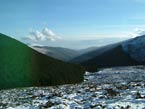
Glenmalure, snow covered. |
Report from Tom Milligan. Pictures: Tom Milligan, Seán Byrne.
The way this walk is organised.
As you will be aware, the Art O'Neill is scheduled to take place at midnight in January each year, starting outside
Dublin Castle. This walk has been organised for members of the Irish Ramblers Club, but over recent years many
non-members have tagged along and have always been welcome. However, due to the fact that non-members are not covered by
club insurance we have decided that it would be unwise to invite all and sundry to participate with us again this year.
If a serious accident were to occur to a non-member and they were not covered by insurance then questions would be asked
about the practice I've adopted in previous years of casually inviting all comers. Nevertheless, if people do turn up
and decide to follow us then we will be happy to have their company but they will do so at their own risk. Please be
mindful of the following:
(1) This is NOT a led walk so you need to be able to navigate if the group moves ahead of you.
(2) There will be NO backup so you will need to bring your own food and have transport at the finish to bring you
home. (Some of us will walk a further 7 miles to Glendalough to get the St. Kevin's bus home).
Participants need to assemble beforehand and be prepared to start at this time. Apart from a brief passage through
some fields, the first 30k is along city streets and country roads to Ballynultagh Gap via Stone Cross. Depending on
your preference, shoes, runners or boots can be worn up to this point. The remaining 22k is over rough mountain terrain
to Barravore in Glenmalure, via Black Hill, Glenbride, Ballinagee Bridge, Art's Cross and Three Lakes. The total
distance is 53k or 33 miles, with a total ascent of 1150m or 3600ft. This walk is not nearly as tough as the Lug Walk,
which has more than twice the ascent. The time taken to cover the route is usually 14+ hrs depending on the weather
conditions and the fitness of the participants.
This is not one of the usual 'supported' walks. In other words there is no entry fee, no backup in the area of food
or transport, and each person or group must be capable of looking after themselves. This means that all food for the
journey must be carried, and transport home from Barravore must be provided by participants. A map and compass,
headtorch, reflective band (for the road walk), whistle, food and rain-gear should be carried by all. Some people will
be walking a further seven miles to Glendalough at the end of the walk to get the bus home
Tom Milligan
tomilligan@eircom.net Ph. 086 0826857
and 2883312.
Report, 2002.
The annual Art O'Neill Walk took place at midnight on Friday night, 4th
January 2002. Twenty-nine people gathered outside Dublin Castle despite dire
warnings from the Met Office of forthcoming bouts of heavy rain and fog. Several
people intending to do the Walk phoned me during that evening and decided to
withdraw from the event because of this. However, the conditions under which the
Walk took place were amongst the best we've encountered for some time. It wasn't
until Templeogue that gentle drizzle prompted us to don our raingear and after a
mile or so it became superfluous. Travelling towards the Stone Cross at
Ballinascorney Gap we saw stars for the first time, although the half-moon
continued to wear its yashmak. For the rest of the Walk it was mild temperatures
and a sunny day equal to any seen in summertime. One gentleman and a lady
withdrew before our first break at Athdown (the lady joined us again at
Ballinagee Bridge) and soon after at Ballynultagh Gap another young man called
it a day. Otherwise 26 people finished the Walk and, despite several cases of
blisters and sore knees, all were pleased to have accomplished their goal. Three
walkers, Tommy Taylor, Tom Milligan (the Methodist/Mormon Alliance) and Pat from
Cork, continued on over Lugduff for a further 8k to Glendalough where their own
transport awaited them in the person of Gerry Maguire. Special mention must be
given to the volunteers who provided unexpected backup for the Walk. Ramblers
Vincent and Angela Murphy, Nollaig and Finola Ceallaigh/McDonald, and Paddy
Hackett with his army of Wayfarers all provided much-appreciated transport for
our boots/bags to Athdown and plied us with soup and sandwiches on our arrival.
Richard More-O'Ferrall provided the kitchen facilities of his excellent
establishment at Jigsaw Cottage, Moyne, Co.Wicklow, by setting up 'Art's
Kitchen' at Ballinagee Bridge when the weary walkers arrived there at 10am. Our
thanks too to all those who provided transport home from Glenmalure. For an
event where no Club funds were used, these volunteers who spent from their own
pockets, without reimbursement, made all the difference between a great social
event and a relentless slog. Many, many thanks to you all!
Tom Milligan
Historical Background, supplied by Tom Milligan
The escape of Art O'Neill and Red Hugh O'Donnell (6th Jan 1592)
Hugh Roe, the son of Hugh, son of Manus O'Donnell, remained in Dublin, in
prison and in chains, after his first escape, to the winter of this year. One
evening he and his companions, Henry and Art, the sons of O'Neill (John), before
they had been brought into the refection house, took an advantage of the
keepers, and knocked off their fetters. They afterwards went to the privy-house,
having with them a very long rope, by the loops of which they let themselves
down through the privy-house, until they reached the deep trench that was around
the castle. They climbed the outer side, until they were on the margin of the
trench. A certain faithful youth, who was in the habit of visiting them, and to
whom they had communicated their secret, came to them at this time, and guided
them. They then proceeded through the streets of the city, mixing with the
people; and no one took more notice of them than of any one else, for they did
not delay at that time to become acquainted with the people of the town; and the
gates of the city were wide open. They afterwards proceeded by every intricate
and difficult place, until they arrived upon the surface of the Red Mountain
over which Hugh had passed in his former escape. The darkness of the night, and
the hurry of their flight (from dread of pursuit), separated the eldest of them
from the rest, namely, Henry O'Neill. Hugh was the greenest of them with respect
to years, but not with respect to prowess. They were grieved at the separation
of Henry from them; but, however, they proceeded onwards, their servant guiding
them along. That night was snowing, so that it was not easy for them to walk,
for they were without sufficient clothes or coverings, having left their outer
garments behind them in the privy-house, through which they had escaped. Art was
more exhausted by this rapid journey than Hugh, for he had been a long time in
captivity, and had become very corpulent from long confinement in the prison. It
was not so with Hugh; he had not yet passed the age of boyhood, and had not yet
done growing and increasing at this period, and his pace and motion were quick
and rapid. When he perceived Art had become feeble, and that his step was
becoming inactive and slow, he requested him to place one arm upon his own
shoulder, and the other upon that of the servant. In this manner they proceeded
on their way until they had crossed the Red Mountain, after which they were
weary and fatigued, and unable to help Art on any further; and as they were not
able to take him with them, they stopped to rest under the shelter of a high
rocky precipice which lay before them. On halting here, they sent the servant to
bring the news to Glenmalur, where dwelt Fiagh, the son of Hugh O'Byrne, who was
then at war with the English. This is a secure and impregnable valley; and many
prisoners who escaped from Dublin were wont to resort to that valley, for they
considered themselves secure there, until they could return to their own
country. When the servant came into the presence of Fiagh, he delivered his
message, and how he had left the youths who had escaped from the city, and
stated that they would not be overtaken alive unless he sent them relief
instantly. Fiagh immediately ordered some of his servants of trust (those in
whom he had most confidence) to go to them, taking with them a man to carry
food, and another to carry ale and beer. This was accordingly done, and they
arrived at the place where the men were. Alas! unhappy and miserable was their
condition on their arrival. Their bodies were covered over with white-bordered
shrouds of hail-stones freezing around them on every side, and their light
clothes and fine-threaded shirts too adhered to their skin; and their large
shoes and leather thongs to their shins and feet; so that, covered as they were
with the snow, it did not appear to the men who had arrived that they were human
beings at all, for they found no life in their members, but just as if they were
dead. They were raised by them from their bed, and they requested of them to
take some of the meat and drink; but this they were not able to avail themselves
of, for every drink they took they rejected again on the instant; so that Art at
length died, and was buried in that place. As to Hugh, after some time, he
retained the beer; and, after drinking it, his energies were restored, except
the use of his two feet, for they were dead members, without feeling, swollen
and blistered by the frost and snow. The men carried him to the valley which we
have mentioned, and he was placed in a sequestered house, in a solitary part of
a dense wood, where he remained under cure until a messenger came privately from
his brother-in-law, the Earl O'Neill, to inquire after him. When the messenger
arrived, he Hugh prepared to depart. It was difficult for him to undertake that
journey, for his feet could not have been healed within the time, so that
another person had to raise him on his horse, and to lift him from his horse,
whenever he wished to alight. Fiagh dispatched a troop of horse with him, who
accompanied him until he crossed the River Liffey, to protect him against the
snares which were laid for him; for the English of Dublin had heard that Hugh
was at Glenmalure, and had therefore posted guards on the shallow fords of the
river, to prevent him and the prisoners who had escaped along with him from
passing into Ulster. The youths who were along with Hugh were obliged to cross a
difficuIt deep ford on the River Liffey, near the city of Dublin; and they
proceeded on their way until they came to the green of the fortress, unperceived
by the English. The people by whom he had been abandoned some time before, after
his first escape, namely, Felim O'Toole and his brother, were amongst the troop
who escorted him to this place; and they made friendship and amity with each
other. They bade him farewell, and having given him their blessing, departed
from him.
The First Escape of Red Hugh
Hugh Roe O'Donnell had now been in captivity in Dublin for the space of three
years and three months. It was a cause of great distress of mind to him to be
thus imprisoned; yet it was not for his own sake that he grieved, but for the
sake of his country, his land, his friends, and kinsmen, who were in bondage
throughout Ireland. He was constantly revolving in his mind the manner in which
he might make his escape. This was not an easy matter for him, for he was
confined in a closely-secured apartment every night in the castle until sunrise
the next day. This castle was surrounded by a wide and very deep ditch, full of
water, across which was a wooden bridge, directly opposite the door of the
fortress; and within and without the door were stationed a stern party of
Englishmen, closely guarding it, so that none might pass in or out without
examination. There is, however, no guard whose vigilance may not some time or
other be baffled. At the very end of winter, as Hugh and a party of his
companions were together, in the beginning of the night, before they were put
into the close cells in which they used to be every night, they took with them a
very long rope to a window which was near them, and by means of the rope they
let themselves down, and alighted upon the bridge that was outside the door of
the fortress. There was a thick iron chain fastened to this door, by which one
closed it when required; through this chain they drove a strong handful of a
piece of timber, and thus fastened the door on the outside, so that they could
not be immediately pursued from the fortress. There was a youth of Hugh's
faithful people outside awaiting their escape, and he met them on coming out,
with two well-tempered swords concealed under his garments; these he gave into
the hand of Hugh, who presented one of them to a certain renowned warrior of
Leinster, Art Kavanagh by name, who was a champion in battle, and a commander in
conflict. As for the guards, they did not perceive the escape for some time; but
when they took notice of it they advanced immediateIy to the door of the castle,
for they thought that they should instantly catch them. Upon coming to the gate,
they could not open it; whereupon they called over to them those who happened to
be in the houses on the other side of the street, opposite the door of the
castle. When these came at the call, and took the piece of timber out of the
chain, and threw open the door for the people in the castle, who then set out,
with a great number of the citizens, in pursuit of the youths who had escaped
from them ; but this was fruitless, for they the fugitives had passed beyond the
walls of the city before they were missed, for the gates of the regal city had
been wide opens at the time; and they pursued their way across the face of the
mountain which lay before them, namely, Sliabh Ruadh, being afraid to venture at
all upon the public road, and never halted in their course until after a
fatiguing journey and travelling, until they had crossed the Red mountain
aforesaid. When, weary and fatigued, they entered a thick wood which lay in
their way, where they remained until morning. They then attempted to depart, for
they did not deem it safe to remain in the wood, from fear of being pursued; but
Hugh was not able to keep pace with his companions, for his white-skinned and
thin feet had been pierced by the furze of the mountain, for his shoes had
fallen off, their seams having been loosened by the wet, which they did not till
then receive. It was great grief to his companions that they could not bring him
any further; and so they bade him farewell, and left him their blessing. He sent
his servant to a certain gentleman of the noble tribes of the province of
Leinster, who lived in a castle in the neighbourhood, to know whether he could
afford them shelter or protection. His name was Felim O'Toole, and he was
previously a friend to Hugh, as he thought, for he had gone to visit him on one
occasion in his prison in Dublin, when they formed a mutual friendship with each
other. The messenger proceeded to the place where Felirn was, and stated to him
the embassy on which he came. Felim was glad at his arrival, and promised that
he would do all the good he could for Hugh; but his friends and kindred did not
allow him to conceal him, from fear of the English government. These learned
that he was in the wood, as we have said, and they (i.e. the people who had
heard that he was in the wood) went in search of him, and dispersed with their
troops to track him. When it was clear to Felim that he Hugh would be
discovered, he and his kinsmen resolved to seize upon him themselves, and bring
him back to the Council in the city. This was accordingly done. When he Hugh
arrived in Dublin, the Council were rejoiced at his return to them; for they
made nothing or light of all the other prisoners and hostages that had escaped
from them. He was again put into the same prison, and iron fetters were put upon
him as tightly as possible; and they watched and guarded him as well as they
could. His escape, thus attempted, and his recapture, became known throughout
the land of Ireland, at which tidings a great gloom came over the Irish people.
(From the Annals of the Four Masters)
<<<
Return to Long Walks Calendar.